
Daily Wisdom: The core characteristics of the realized person according to Hassidic master Mordechai Lainer’s teaching

They point out the highly humanistic undertone of Lainer’s non dualism.
1) Affirming and honoring of the unique individuality of every person.
2) Engendering of human freedom and empowerment.
3) Affirms the necessity, ontological impact, and dignity of human activism.
4) Affirms the ontic idenity between the human and divine name as the empowering realization of enlightenment.
5) Affirming of the ontological dignity of human desire and viewing it as an important normative guide.
6) Affirming the ontological dignity and authority of the human capacity to employ trans-rational faculties, “Lemaalaha MiDaato”, in apprehending the unmediated will of God.
7) Affirms the centrality of will and the ultimate ontic identity between the will of God and the will of the awakened person, who has achieved post Berur consciousness.
8) Views not only the Tzaddik but that every person, Berur awakened state, as a source of ultimate moral and legal authority. We have termed this the “democratization of enlightenment.”
What is remarkable about Lainer’s thought is not that all of these features are present. Indeed many of them could be easily identified in many writers on secular humanism. What is unique is that all of these flow directly not from a secular perspective but from a radical non dualism which affirms that all is God. The idea that the human being substantively participates in divinity is the conceptual matrix which radically empowers and frees the human being.
Dr. Marc Gafni
The Dance of Tears
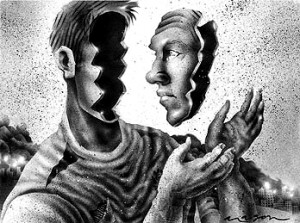 Divinity has one ultimate secret, which it will also whisper in your ear if your mind becomes quieter than the fog at sunset: the God of this world is found within, and you know it is found within: in those hushed silent times when the mind becomes still, the body relaxes into infinity, the senses expand to become one with the world–in those glistening times, a subtle luminosity, a serene radiance, a brilliantly transparent clarity shimmers as the true nature of all manifestation, erupting every now and then in a compassionate Radiance before whom all idols retreat, a Love so fierce it adoringly embraces both light and dark, both good and evil, both pleasure and pain equally; for “I make the Light to fall on the good and bad alike; I the Lord do all these things”; a passionately embroiling Heat so painful it will melt your bones while you hurl yourself to the ground with awe and supplication and reverence and surrender.
 God is the possibility of possibility – limitless imagination. The first of the ten commandments is “I am God.” When this God is asked to identify himself, He responds, “I will be what I will be.” That is, ”˜You cannot capture me in the frozen image of any time or place. To do so would be to destroy me.’ It would be to violate the second commandment against idolatry. Idolatry is the freezing of God in a static image. To freeze God in an image is to violate the invitation of the imagination. It is to limit possibility.
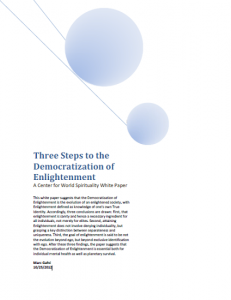 This white paper, “Three Steps to the Democratization of Enlightenment,” by Marc Gafni suggests that the Democratization of Enlightenment is the evolution of an enlightened society, with Enlightenment defined as knowledge of one’s own True Identity. Accordingly, three conclusions are drawn: First, that enlightenment is sanity and hence a necessary ingredient for all individuals, not merely for elites. Second, attaining Enlightenment does not involve denying individuality, but grasping a key distinction between separateness and uniqueness. Third, the goal of enlightenment is said to be not the evolution beyond ego, but beyond exclusive identification with ego. After these three findings, the
  Whether the relationship is that of a servant to his master or a lover and his beloved or a relationship between partners or even friends, they are all “relating” to God.
 Sacred hermeneutic is ultimately an erotic act according to the mystics in which the God in the interpreter meets the God and the text and realizes that they are one.
 Every evolved culture and every evolved individual may realize Unique Self when True Self awakens to its Unique Perspective. An early expression of this equation is sourced in pre-modernity in the great teachings of the Kabbalists. For these masters, the sacred text of the Torah is the word of God. Yet, paradoxically, in Hebrew mystical teaching a human being who is deeply grounded in True Self while fully incarnating his or her own uniqueness, also speaks the word of God!
 R. Kook, twentieth century philosopher mystic, teaches that every generation is part of the unfolding revelation of divinity. Each generation, picking up from where the last one left off, moves closer to understanding the full depth and divinity of sacred rites and passages. In this sense the “covenant between me and the children of Israel” is not only between God and the people – but “between” the children of Israel”. and their children ….and their children – a covenant between generations. Israel means for me, borrowing a reading from my teacher Mordechai Lainer of Izbica, based on a close and creative reading of the original Hebrew, Yashar El; the direct apprehension of the divine.