
Daily Wisdom: As You Love Yourself
 Of course, to remind another of their full beauty you have to be fully aware of your own. The Baal Shem Tov has a wonderful teaching on the biblical mandate “love your neighbor as you love yourself.” First it is a statement of fact–you love your neighbor precisely as much as you love yourself. For in the end, you can only perceive another’s greatness if you have glimpsed and believe in your own. Self-love is self-perception.
If this is so, then a powerful question arises. How do you love yourself when you know all of your foibles pathologies and blemishes? Isn’t self-love self-perception? And does not honest perception yield forth all of the reasons why we are not lovable? And yet most of us manage, at least to some degree, to love ourselves. Is it just self-deception? No, not at all. Love is not merely perception, it is a perception-identification complex. Self-perception means that although you are aware of the full complexity of your personae–the good, the bad, and the ugly–you identify the essence of who you are with your good–your good, loving, giving, creative, and generous self.
That does not mean that you deny your beast. It is, of course, critical to integrate all of you into your self picture. To love yourself is to identify yourself as part of the Shechina. Writes the Baal Shem Tov, “To love yourself is to love the Shechina.” Not to love yourself is to send the Shechina into exile. So proclaim the Kabbalists, to which Rumi adds:
By God, when you see your beauty
You will be the idol of yourself.
In your deepest nature you must know that you are the hero of your story. In your deepest nature you are love and grace and strength and splendor. Now you must decide to identify with your deepest nature. Do you focus on your innocence or your guilt? Do you focus on your ever-inevitably dirty hands, or on your ever-eternally pure soul? To love yourself or anyone else, you need to know that your innocence is your essence. That you always remain worthy of love. That your innocence is never lost.
The Mystery of Love
Dr. Marc Gafni
Pages 121, 122
World Spirituality Unplugged: From Jerusalem to Tibet with Love: Marc Gafni and Dalai Lama in 2008
Marc Gafni (from his 2008 dialogue with the Dalai Lama):
To love someone is to see them with God’s eyes, to perceive them at their highest place, like — as His Holiness said — the mother who sees the baby. The mother, no matter what the baby does when older, always sees the baby as divine. Therefore we call God in Hebrew mysticism, Kabbalah, the divine breast of the Mother who feeds us all.
So we are all, like God, trying to see Other with God’s eyes. So to love is to see with God’s eyes, not an emotion, but a perception. … That’s our basic idea. So we say we can train people to love. Because if love is an emotion, we can’t train an emotion. But we can train a perception. We can train people to see.
So good Hebrew teaching is to train people to see… and to give… The Hebrew word for “love” also means “to give” and “ecstasy”… Ecstatic emotion that comes from giving. In Hebrew tradition, I first give, and if I give, I love. That’s just a gentle wisdom from Jerusalem to Tibet. Thank you so much for your wisdom on loving…
Note: This post originally appeared on Marc Gafni’s Tumblr page.
Daily Wisdom: Godot is waiting for us
 Dr. Marc Gafni:
God is called in biblical myth “Shadai,” translated by the wisdom masters as, “He who said to his world, ”˜Dai’–enough.” Two meanings well up from the word.
The second meaning is that God turns to you and me and says, “Enough. You are enough! Know that you are worthy enough to be called to the ultimate service of tikkun, the healing and repair of the world.”
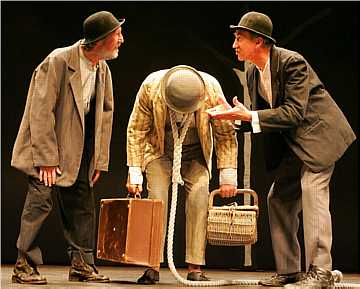
For God to give up full control means, for the Hebrew mystic, an invitation to the most exhilarating, ecstatic and overwhelming partnership that the universe can offer. It is not us waiting for Godot; instead, Godot is waiting for us. God’s echo is heard in the voice of the prophet. “Why did I come and there was no one? Why did I call and there was no response?”
The Erotic and the Holy
Daily Wisdom: Find your Voice!
 Only someone who chooses to step into her story can find voice and respond to her call.
Ah! From the soul itself must issue forth
A light, a glory, a fair luminous cloud,
Enveloping the Earth-
And from the soul itself must be there sent
A sweet and potent voice, of its own birth,
Of all sweet sounds the life and element
–Coleridge
(as quoted by Dr. Marc Gafni in Dance of Tears)
Unique Self and Creating Your Life on Purpose
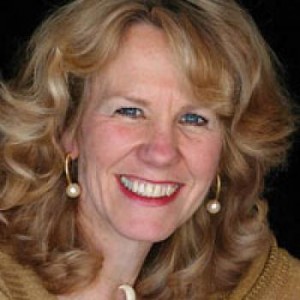 Join us for a new free event, “Unique Self and Creating your Life on Purpose”! On Thursday, Dec 6 at 6pm PT (9pm PT) Marc Gafni with be joined by Anodea Judith, author of Creating on Purpose, for a spirited discussion about the ideas contained in both their new books.
For more information, see:
http://uniqueself.com/welcome-friends-of-anodea-judith/
http://www.creatingonpurpose.net/Home_Page.html
Long concerned with the future of humanity, and passionate about awakening our collective potential, Anodea Judith has dedicated her life to healing the wounds in our personal and collective psyches. Her best-selling books on the chakras and global change have placed her among the evolutionary thought leaders of our time.
Anodea Judith holds a doctorate in Health and Human Services, with a speciality in Mind-Body healing, and a Master’s in Clinical Psychology. Her best-selling books on the chakra system, marrying Eastern and Western disciplines, have been considered groundbreaking in the field of Transpersonal Psychology and used as definitive texts in the U.S. and abroad. With over 500,000 books in print, and translations in 15 languages, her books have won her the reputation of solid scholarship and international renown as a dynamic speaker and workshop leader.
Anodea is founder and director of Sacred Centers, a teaching organization for life-affirming paths of wisdom. She taught with Lion Goodman for many years, co-creating the material for manifestation through the chakras through their many workshops worldwide.
Daily Wisdom: On Baseball and Life’s Other Great Questions
My uncle used to tell this story every year at his birthday celebration.
There were once two best friends who loved baseball. Their great theological question in life was whether there is baseball in heaven. So they make a pact that whoever passes away first will come back and tell the other whether there is baseball in heaven! Well, one passed away and sure enough, true to their pact, appears to his friend in a dream several days later.
“Well,” asks the surviving friend, “tell me already – is it good news or bad news?”
“Truth is,” comes the response, “it is both good news and bad news.”
“Well what’s the good news?”
“The good news is there is most certainly baseball in heaven. Not only that but there’s the finest diamond you could imagine. Moreover all the greats are here. DiMaggio, Ruth, Cobb”¦and we get to play with them. Everyday you look and you see what teams are up for the next week.”
His friend is overwhelmed with the good news. “That is fabulous!” he responds. “After all that, what could the bad new possibly be?”
“Well, I just looked at the lineup”¦and tomorrow” you’re up to bat.”
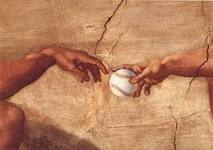 There were once two best friends who loved baseball. Their great theological question in life was whether there is baseball in heaven. So they make a pact that whoever passes away first will come back and tell the other whether there is baseball in heaven! Well, one passed away and sure enough, true to their pact, appears to his friend in a dream several days later.
As long as we think we will live forever, we can afford to ignore ultimate issues. But once the simple truth that we are all “up to bat tomorrow” is internalized, then the search for meaning becomes a central concern.
Of course, there are appropriately many different answers as to what constitutes meaning. What is absolutely intriguing, though, is that all of the great systems of spirit viewed some form of significant giving beyond the circle of family as being essential to a life well lived!
You cannot be a lover without being committed to the growth of a community beyond your own circle.
Dr. Marc Gafni
The Erotic and the Holy
Daily Wisdom: He becomes the Language of God….
 The human self understanding as “King,” stems from the insight, fruit of all serious spiritual practice, that all of reality is included in the divine. Once one realizes that all is the Godhead then one may draw one of two conclusions. First, one might say, well if all is God then I must immediately nullify and surrender to God. And that is good. However one might also say – if all is God, then I am God as well. And that is much better. For the first realization produces what Jewish, Christian and Eastern mystics have called Via Passiva. It’s a passivism, even a kind of resignation which results from the realization that human action is but illusion and the only will which is real is the will of God.
The second far deeper realization understands that if the human being is part of God then he is ultimately liberated. All of his actions count infinitely. He becomes the language of God. God’s adjectives, nouns, verbs, even God’s dangling modifiers. His identification with the divine is not emasculating at all. On the contrary it is radically liberating and empowering. His realization that there is nothing in the cosmos independent of God, the realization that is formally termed acosmism, yields not a tepid quietism but rather, what we have termed an audacious and impassioned “Non Dual Humanism.”
Dr. Marc Gafni
The Dance of Tears
(2013)
Marc Gafni and Dada Nabhanillananda
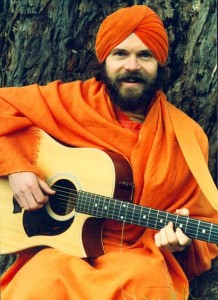 On December 4 at 9 a.m. PT, Dr. Marc Gafni will be in dialogue with Dada Nabhanillananda, known as the Yoga Dude ”” a teacher, yoga activist and musician, on his free Imaginal World teleseminar series, “Creating a World Based on Love.” Marc and Dada will explore Unique Self enlightenment and diverse facets from Marc’s award-winning new book, Your Unique Self: The Radical Path to Personal Enlightenment. Tune in as well for special offer of a one-time-only curated set of Marc’s wonderful teaching resources.
You can check it out and sign up here:
http://www.imaginalworld.com/love/marc/invite/
Acharya Nabhaniilananda normally called “Dada”, is a senior meditation instructor of Ananda Marga, an authority on Yoga philosophy, a published author and a popular musician. In 2011 his song “The Love Remains” was a finalist in the prestigious Song of the Year International Songwriting Contest.
Dada was born in New Zealand in 1955 of English parents. During his early life he studied classical music and poetry. At the age of 11 he started composing music for the piano, and his teachers had high hopes of him becoming a concert pianist. However, during his time as a University student he developed a deep interest in Eastern mysticism. In 1975 he left his native land for Australia, and later Nepal and India where he studied the disciplines and philosophy of Yoga and Meditation within sight of the Himalayas, and was ordained as a Yoga Monk in 1979.
Dada plays melodic folk rock in the style of Simon & Garfunkel or Cat Stevens. He sings about spiritual experiences and ecological or human rights issues, and derives many of his ideas from myths and legends of different cultures. His early musical influences include folk singers Donovan and Don Mclean, and 70’s bands Yes, Crosby Stills Nash & Young, Genesis & Santana. Dada’s immersion in eastern mysticism adds a deeper dimension to his music, giving it a lasting quality.
Dada has been recording and performing since 1984, and has played on every continent save Antarctica. He frequently appears at ecological protests or alternative festivals where his songs and audio-visual presentations about the environment are always well received.
Daily Wisdom: I cannot do it alone…..
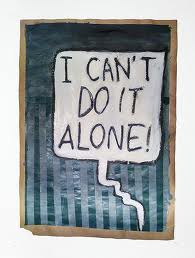 In the image of the Temple, we are told of the priest who hears the voice of God, praying. To whom could God be praying? The answer — to us. “Please,” says the Voice. “I cannot do it alone. Please help me…”
Effectively, the gift of love which gives up unilateral control is nothing less than the gift of need. To say “I love you” is to say “I will not or cannot do it alone.” To say “I love you” is to say “I need you.” God needs our service!” is the great and radical cry of the Hebrew mystics. “I need you at my side. Are you willing to stand by me?”
Marc Gafni
The Erotic and the Holy
Daily Wisdom: Chogyam Trungpa Rinpoche’s Ideal of “No Practice”
Ken Wilber writes in “The Spirituality That Transforms”:
When Chogyam Trungpa Rinpoche, a great (though controversial) Tibetan master, first came to this country, he was renown for always saying, when asked the meaning of Vajrayana, “There is only Ati.” In other words, there is only the enlightened mind wherever you look. The ego, samsara, maya and illusion — all of them do not have to be gotten rid of, because none of them actually exist: There is only Ati, there is only Spirit, there is only God, there is only nondual Consciousness anywhere in existence.
Virtually nobody got it — nobody was ready for this radical and authentic realization of always-already truth — and so Trungpa eventually introduced a whole series of “lesser” practices leading up to this radical and ultimate “no practice.” He introduced the Nine Yanas as the foundation of practice — in other words, he introduced nine stages or levels of practice, culminating in the ultimate “no practice” of always-already Ati.
Many of these practices were simply translative, and some were what we might call “lesser transformative” practices: miniature transformations that made the bodymind more susceptible to radical, already-accomplished enlightenment. These translative and lesser practices issued forth in the “perfect practice” of no practice — or the radical, instantaneous, authentic realization that, from the very beginning, there is only Ati. So even though ultimate transformation was the prior goal and ever-present ground, Trungpa had to introduce translative and lesser practices in order to prepare people for the obviousness of what is.
Read the entire article. Ken Wilber is a leading voice in the Integral World Spirituality movement, and more of his writings can be found on www.kenwilber.com.
World Spirituality Unplugged: Four Audiences for World Spirituality
Recorded in 2010, Marc Gafni’s “Who’s Out There? Dual Citizens?” explores the audiences for a World Spirituality.
There are two broad groups of people out there we need to understand as we lay the foundation for spirit’s next move, an emergent World Spirituality.
Group One. People who are part of an ethnocentric religion (“We got the truth, you don’t,”) 70% of the world is hanging out over there.
The second group is people who have for whatever set of religion moved beyond the world religions. Christianity, Judaism, Islam, Buddhism, Confucianism, Taoism, whatever. They no longer view themselves as part of the classical religions. Moreover, they don’t feel comfortable in the classical religions. They don’t feel held, addressed, compelled, invited.
Why? Lots of different reasons. Some of them may have actually internalized the critique of the religions introduced by modern thinking and post-modern thinking ” and we’ll look at those critiques and where they are relevant and overstated. But whatever those critiques are, they have been incorporated into the Zeitgeist, the very fabric of our contemporary context.
Watch the video and read further below:
For privacy reasons YouTube needs your permission to be loaded.
I AcceptPeople grow up today in a world without feeling they needed to be part of a religion. That wasn’t true before. Three hundred years ago that was a given. What the modern and postmodern critiques have done is enable the possibility of people to grow up and say they are beyond religions or spirituality, to say that they are beyond that. That’s group two. They don’t practice any spirituality or religion. They are living their lives generally guided by reason. They are global citizens fully removed from the religious or spiritual context.
Group three. Tens of millions of people are primary candidates for World Spirituality. Actually this group of people which might be you and might be me are already practicing a sort of World Spirituality. They are drawing from this and that seminar they went to, piecing together with bubble gum and tape some sort of spiritual life. They are citizens of the world. They don’t feel limited. They may live in a country and have some sort of loyalty, but the way they feel is that they are global citizens. Their practice is put together from different places. It is not coherent, but they are trying to find their way without rooting themselves in any particular religion. They don’t feel comfortable in any particular religion.
Group four. You may well be part of this fourth group as well –most people listening to these conversations on World Spirituality fit into group three or four. They are what we like to call in the Center for World Spirituality, dual citizens. You are a member of a particular religion: let’s say Christianity. But you are trying to evolve Christianity, you are trying to engaged in some movement of renewal of Christianity, even as you are deeply connected to Christ, Christ Consciousness, the great teaching that has come down to you. Or you might be Islamic or Buddhist or from a native religion. You are part of a religion and yet that religion doesn’t exhaust your identity. It’s not the only true religion. You practice in that system. You’re a citizen in that system. While at the same time, you’re part of the larger context of the world scene. You are a citizen of a particular religion, and a citizen of a World Spirituality.
A World Spirituality will speak to all four groups in different ways.
It will challenge the first group if it’s compelling and deep: the people who are committed to only one religion as their only and exclusive practice. What critiques do they have of a World Spirituality that are valuable and compelling?
It will challenge the second group if it offers a genuine possibility of moving beyond a religion of reason: a religion of reason leaves people profoundly empty and directionless but they don’t want to go to the religions. They aren’t aware that there is an alternative. It will speak powerfully to them if science and religion are appropriately integrated.
It will speak to group three – people who are naturally already trying to piece together their deep engagement with spirituality. It will help them organize their core principles. They are practicing some sort of de facto practicing some sort of world spirituality but are confused. They have a new seminar every three weeks. They’re trying to piece it together with their friends, but they’re not sure what values to pass down to their children.
What we want to do through World Spirituality is to offer a cogent, cohesive vision to help people guide their way as we begin together to unfold this new move of spirit.
It will also speak to the dual citizens because it will offer people a cogent vision of World Spirituality that is informed by and influenced by their chosen tradition as well as move beyond it into a World Spirituality.
World Spirituality is a compelling necessity of spirit’s unfolding for all four of these groups of people living today.
Daily Wisdom: Tears in a cross-cultural perspective
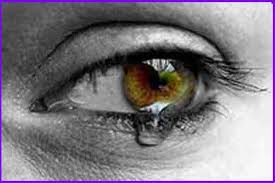 Tears or their absence in every culture across time are considered the signposts of spirit glimmerings of eternity and whisperings of divinity. Tears are the divine whisper which utters the secret of our destiny in a tear drop. Heinrich Heine cries out in ecstatic rapture, “What poetry there is in tears;” Hebrew Wisdom would add, “What Wisdom there is in tears.”
A central mystical practice is to keep a tears journal. Identify the five major episodes of crying in the last twenty years of your life. Then give voice to those tears. Language them even though their truths are beyond words. You will hear the voice of God speaking directly to you with much of the wisdom, courage and direction you need to guide your life. For the Zohar when tears are present we know that God is present.
“The Sava wept and his tears fell upon his beard.
He said, Sava, weary in strength,
How wonderful are these tears upon your beard!
They are as wonderful as the goodly anointing oil
That would fall on the good white beard of Aaron.
Speak your words Sava,
For the holy King is present.”
The Sava takes the wondrous sight of his tears as a sign that God is present. For the Sava the presence of tears equals the presence of God.
Thus to understand the language of tears is to know the language of God.
Dr. Marc Gafni
The Dance of Tears
(in press)
World Spirituality Unplugged: World Spirituality is an Evolutionary Emergent
In this 2010 video, presented in our World Spirituality Unplugged series, there is a rousing call to see the “revolution in possibility” which is an evolutionary emergent in spirituality. From Marc Gafni:
In the world, everyone agrees that we see this evolution from simple to complex, greater levels of complexity, of depth and consciousness. This vision of a World Spirituality is an evolutionary emergent – it’s something new, has never existed before. There are glimmerings of it, hints of it, and in other conversations I will share with you the hints, precursors, the foreshadowings of this World Spirituality that is now bursting forth”
This World Spirituality, Gafni says, allows people to be both part of their own tradition as well as part of a global movement that goes beyond it.
For privacy reasons YouTube needs your permission to be loaded.
I AcceptDaily Wisdom: Transformation of Identity
 Unique Self mystics in the old Aramaic texts spoke of two paths, itcafya and ithapcha.
The higher path is called ithapcha, which means “to transform.” In the language of the mystics, it means to transform “the bitter to the sweet.” The bitter is not erased or diluted, however. The bitter becomes the pointing-out instruction for the sweet. Ithapcha is the way of the dragon. It is far more that just making peace with your “dark side.” It is the transformation of identity, which is an act of memory. You remember that you have forgotten. You have forgotten that you are Source.
In the language of one Unique Self mystic, the master Abraham Kook:
The primary transformation
Which reveals the light in the
darkness
Is that a person returns to himself
To the root of his soul
And that in itself
Is to return to God
Who is the soul of all souls.
Dr. Marc Gafni
Your Unique Self: The Radical Path to Personal Enlightenment (p. 282).
Ingram Distribution. Kindle Edition.
Daily Wisdom: Alexander and the Eye of Acquisition
A Story from Marc Gafni:
The rapist, the corporate raider, the Don Juan, and the conqueror are always taking. The sad result is that they never give and therefore never receive. Therefore, the more they take, the less they have. As a result they always remain empty. For many of the biblical mystics, the symbol of conquest was Alexander the Great. He took almost the entire known world of his day. Yet, insisted the masters, without becoming a lover, Alexander would necessarily remain empty.
The legend tells of Alexander finding the Garden of Eden, symbol of all fulfillment, on the African continent. Now the Talmudic masters have a little bit of a soft spot for Alexander. They saw in him not only a conqueror but also a wisdom seeker. So along the way to Eden, Alexander is depicted as growing wiser and slowly divesting the personality of a pure taker.
In one of his adventures Alexander is confronted by an army of women warriors – mythological symbols of Eros and Shechina. They say to him, “It is not worth your while to attack us. For if we kill you – you will be known as ”˜the king killed by women,’ and if you kill us you will be known as ”˜the cruel king who killed women.’” A lesson in the futility of taking.
Next, Alexander asks these same women for bread to eat. Instead, they serve him loaves of gold. In response to his astonishment they reply, “You have enough bread in your own city. You came all the way here because bread would not fill you – you needed gold.” Second lesson – the clarification of desire. Be honest about what you need to fill you.
At this point, Alexander is ready to encounter the Garden of Eden. He eats some fish and recognizes by its scent that the water was from Eden. He finds the gates of the Garden and cries out “Entry!” He is refused access. He is not yet enlightened. Alexander pleads to receive at least some of Eden’s wisdom. From behind the gate extends a gift – it is an eyeball. Sensing its magical quality, Alexander has the eyeball inspected and weighed. Turns out this small object weighs more than all the masses of gold and silver he has with him.
“How could this be?” he asks his sages in consternation. They reply that this is a human eyeball – representing desire that can never be satisfied.
This is desire in the sense of taking, instead of giving and receiving. Human desire is so heavy that it weighs man down. Without a doubt it weighs more than all the gold and silver that Alexander could carry with him. Yet, unconvinced, Alexander asked the sages for proof. They sprinkled some dust over the eyeball so it could no longer see, and it immediately reverts to its natural weight.
On Alexander’s quest for wisdom, he needed to learn the futility of taking. Alexander is empty, as is symbolized in his request for food to fill him. The warrior women of Eros teach him to be clear about his desires. Gold and not bread. Do not pretend to be working for your core survival (bread) when it is really gold (honor and glory) that you are after. Finally, know that your desire can never be sated, even by all the world’s gold and silver. The human eye of acquisition is a black hole of desire, always demanding more. You need to change your essential relationship to the world. Let go of taking and embrace the law of love – that law is, only in the natural exchange of giving and receiving will you ever become full.
World Spirituality Unplugged: “All Religions are Not the Same!!!”
In this 2010 video from the Center for World Spirituality archives, Dr. Marc Gafni articulates a vision for World Spirituality based on a ranking of worldviews into a new hierarchy of truth, beauty, and goodness. He says, in part:
There are two people today. Ethnocentric = my nationality, my religion, my group has got it going on. Augustine: there is no redemption outside of the church. There are about 30 percent of the world that have transcended: trance-ended. That’s how I like to teach that word. To end the trance of. They have ended the trance of the ethnocentric context that says our system is the superior system. A lot of people who are holding that belief including many people who are very loving and beautiful are still holding that belief.
For privacy reasons YouTube needs your permission to be loaded.
I Accept